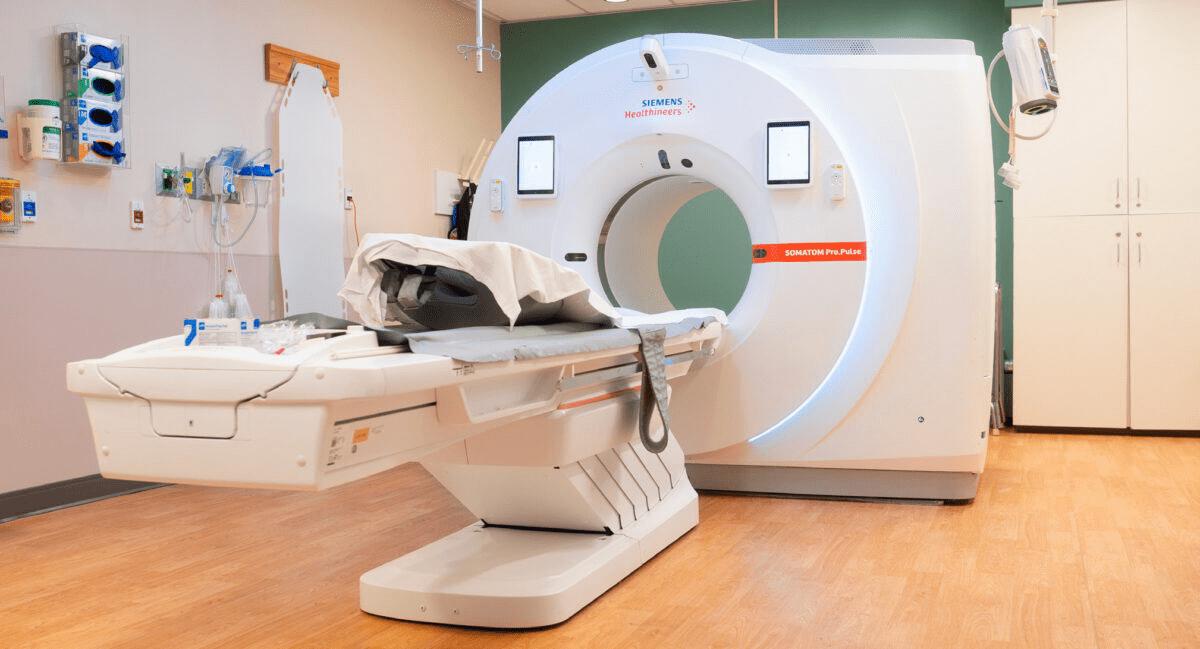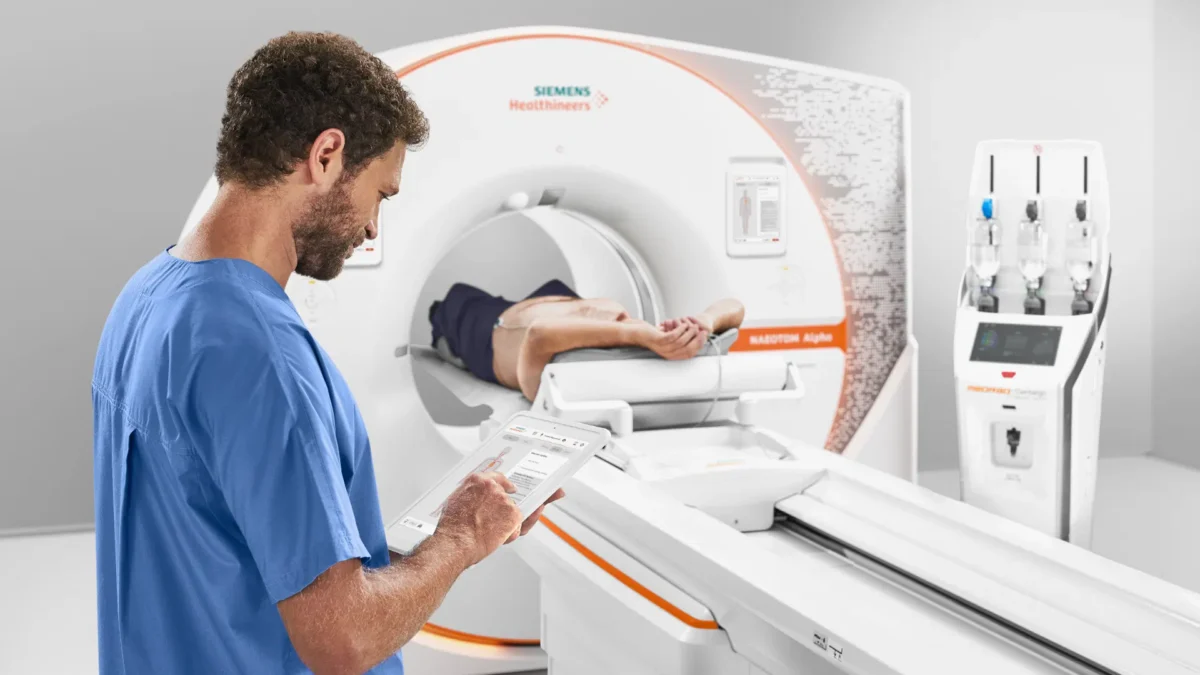

Siemens Healthineers released the world’s first commercially available photon-counting CT scanner, the NAEOTOM Alpha, in 2021. Built on photon-counting CT technology, it changed what a single scan could show, and for hospital imaging teams, it set the bar for CT purchases. The detector at the center of the system is what makes that possible. It changes both the images you can produce and the range of patients you can serve.
The NAEOTOM Alpha has since grown into a three-model class: the NAEOTOM Alpha.Peak, Alpha.Pro, and Alpha.Prime. Siemens Healthineers introduced this class at the Radiological Society of North America (RSNA) 2024 conference.
This guide walks through the Alpha class, covering the three models, how each one fits in real-world clinical applications, and full specifications for teams evaluating a purchase. Every model in the Alpha class rests on that same detector approach, which measures the energy of every X-ray rather than reading a combined signal.
What Is the NAEOTOM Alpha?
The three systems in the NAEOTOM Alpha class share the same QuantaMax photon-counting detector technology, but their detector configurations and source configurations differ. The Alpha.Peak and Alpha.Pro are dual-source systems, while the Alpha.Prime is single-source. All three use the QuantaMax photon-counting detector, which is what separates the class from conventional CT.
The difference lies in the detector. A conventional CT detector converts X-rays into light and then into a signal, adding electronic noise and discarding energy information. The QuantaMax detector converts each X-ray straight into an electrical charge and measures its energy.
Direct conversion gives the NAEOTOM Alpha features conventional systems do not offer. The first is spectral information in every scan. The second is high spatial resolution without the electronic noise that limits older detectors. Since its debut, the system has scanned more than one million patients worldwide.
The NAEOTOM Alpha Class: Peak, Pro, and Prime
Choosing among the three models is the first decision a facility faces. The NAEOTOM Alpha class covers three systems that share the same detector. The systems differ in source configuration, detector coverage, temporal resolution, and scan speed, so matching the model to a facility’s caseload is a practical decision.
- Alpha.Peak: This is the high-end dual-source model. It reaches a scan speed of up to 737 mm/s, which suits facilities that need a high level of clinical performance for cardiac and trauma work.
- Alpha.Pro: The Alpha.Pro is the second dual-source system. It pairs the same 66 ms temporal resolution as the Peak with scan speeds up to 491 mm/s. The resolution and speed make it fit for pulmonology, pediatrics, and cardiology, where shorter breath-holds and less sedation help.
- Alpha.Prime: This system is a single-source scanner at 345 mm/s. The system brings photon-counting into a wider range of settings, including inpatient, ambulatory, and emergency imaging.
Siemens Healthineers introduced the expanded class at RSNA 2024. The company renamed the original system the Alpha.Peak and added the Alpha.Pro and Alpha.Prime. To see what these figures mean in practice, it helps to compare them with a conventional system in photon-counting vs conventional CT.
Why the NAEOTOM Alpha Matters
Speed and model choice describe what the system is. The reasons it matters show up in daily imaging.
- Spectral information in every scan: Spectral information is acquired with every scan without requiring a separate dual-energy acquisition. Material-specific and virtual monoenergetic images can then be reconstructed when clinically needed. That capability traces back to how the QuantaMax detector reads energy, explained in full in Siemens Healthineers photon-counting technology.
- AI and workflow automation: myExam Companion guides each scan, and zero-click Recon&GO automates image reconstruction, which supports throughput and reduces manual steps for busy departments.
- Wider patient access: The 82 cm bore and high dose efficiency support positioning and accommodation of larger or mobility-limited patients, widening the range of people a facility can image.
Each of these strengths answers a different clinical problem. Its value shows up unevenly from one service line to the next.
Clinical Applications by Department
The NAEOTOM Alpha earns its place department by department, and the fit is clearest when matched to the imaging problem each service line deals with.
| Department | Where the NAEOTOM Alpha Helps |
| Cardiovascular | High-resolution and spectral data help clinicians see through heavy calcification and stents. These features support coronary assessment in challenging patients. |
| Oncology | Low-dose spectral imaging aids tumor characterization and follow-up. |
| Neurology | Fine spatial detail supports assessment of small vessels and structures, including stroke and aneurysm work. |
| Pulmonology | High-resolution, low-dose lung imaging serves vulnerable patients. |
| Musculoskeletal | The resolution brings out fine bone and soft-tissue detail. |
| Pediatrics | Low-dose and fast acquisition open the potential to scan some children without sedation. |
The class also reaches emergency and interventional settings. Fast dual-source acquisition up to 737 mm/s suits unstable trauma patients. The single-source Alpha.Prime extends photon-counting into emergency and ambulatory departments. Spectral and high-resolution imaging also supports interventional planning, such as coronary calcium quantification ahead of cath-lab procedures.
What the NAEOTOM Alpha Means for Your Facility
Case mix determines how much new work a department can take on and how smoothly it fits into daily operations. The system widens what a department can serve, from routine studies to more complex cases. It supports throughput with fast dual-source acquisition and delivers spectral data on every scan without extra protocols.
A photon-counting system is a significant investment, and siting calls for planning around space, power, and shielding early. Those are the conversations worth having early, with numbers and clinical goals side by side.
This is where local support and deep expertise count. Centella is the Siemens Healthineers Advanced Partner for South Florida. The team helps a facility evaluate the system, plan the install, and provide quality support after it is live. Bringing photon-counting into a department is as much a partnership question as a purchase, and that is the role Centella fills.
Frequently Asked Questions About NAEOTOM Alpha
A few questions come up when teams first look at the NAEOTOM Alpha class.
What Is the NAEOTOM Alpha?
The NAEOTOM Alpha is the world’s first photon-counting CT scanner from Siemens Healthineers. It uses QuantaMax photon-counting detectors that measure the energy of each X-ray, which produces spectral data on every scan along with high spatial resolution at low dose. It now comes as a three-model class: the Alpha.Peak, Alpha.Pro, and Alpha.Prime. The three share the same detector but differ in source configuration and scan speed to match different caseloads.
What Are the NAEOTOM Alpha’s Specifications?
The high-end dual-source system carries two QuantaMax photon-counting detectors and two Vectron X-ray tubes. Its performance figures include temporal resolution down to 66 ms, in-plane spatial resolution of 0.11 mm in Quantum HD mode, and scan speeds up to 737 mm/s. The system also has an 82 cm bore and a table load capacity of up to 340 kg (750 lbs). Power output reaches 2 x 120 kW, with current up to 1,300 mA.
Is the NAEOTOM Alpha the First Photon-Counting CT?
Siemens Healthineers introduced the NAEOTOM Alpha in 2021 as the first photon-counting CT cleared for clinical use. The system has scanned more than one million patients worldwide since that debut. Other manufacturers have since entered the photon-counting field, so it is first to market today rather than the only option. It remains the longest-established photon-counting system in clinical use.
What Is the Difference Between NAEOTOM Alpha.Peak, Alpha.Pro, and Alpha.Prime?
The three models share the same detector but differ in configuration and speed. The Alpha.Peak is the high-end dual-source system at up to 737 mm/s. The Alpha.Pro is a second dual-source system at up to 491 mm/s with 66 ms temporal resolution. The Alpha.Prime is a single-source scanner at 345 mm/s, built for inpatient, ambulatory, and emergency use, extending photon-counting into settings beyond specialized imaging suites.
How Fast Is the NAEOTOM Alpha?
Scan speed depends on the model. The dual-source Alpha.Peak reaches up to 737 mm/s, the dual-source Alpha.Pro up to 491 mm/s, and the single-source Alpha.Prime up to 345 mm/s. The two dual-source systems share a temporal resolution of 66 ms, which supports cardiac and trauma imaging where motion is a factor. The faster dual-source models suit unstable trauma patients, while the Alpha.Prime brings photon-counting speed into inpatient and emergency settings.
What Is the Spatial Resolution of the NAEOTOM Alpha?
In Quantum HD mode, the system delivers in-plane spatial resolution of 0.11 mm and slice thickness down to 0.2 mm. That level of detail helps clinicians assess small structures, from coronary vessels to fine bone anatomy, without raising the patient’s radiation dose. This resolution comes from the QuantaMax photon-counting detector, which measures the energy of each X-ray directly instead of converting it to light first. That direct measurement cuts the electronic noise that limits image detail on conventional CT.
What Clinical Applications Is the NAEOTOM Alpha Used For?
The NAEOTOM Alpha supports cardiovascular, oncology, neurology, pulmonology, musculoskeletal, and pediatric imaging. Its spectral data and high resolution help in cases with heavy calcification or stents, in low-dose tumor follow-up, and in small-vessel neurological work. The fast dual-source models also suit emergency and trauma imaging. Local support from a partner such as Centella helps a facility match each model to the department that needs it most.
How Is the NAEOTOM Alpha Different from a Conventional CT Scanner?
A conventional CT detector converts X-rays into light before creating a signal, which adds electronic noise and discards energy data. The photon-counting detector converts each X-ray straight into an electrical charge and measures its energy. The result is spectral information on every scan, high spatial resolution, and low electronic noise than a conventional system produces. None of it requires a separate specialized acquisition or protocol.
Does the NAEOTOM Alpha Reduce Radiation Dose?
The NAEOTOM Alpha is built for high dose efficiency. Because the photon-counting detector removes electronic noise from the signal, it can produce high-resolution images at low dose, which is valuable for pediatric and other sensitive patients. That lower contrast burden matters most for patients with renal impairment or contrast sensitivity.
Where Can Hospitals in South Florida Get the NAEOTOM Alpha?
Centella is the Siemens Healthineers Advanced Partner for South Florida. The team helps hospitals and imaging centers in the region evaluate the NAEOTOM Alpha, plan installation, and provide support after the system goes live. A conversation with a Centella specialist is the best starting point for matching the right model, Peak, Pro, or Prime, to your service lines and caseload.
Match the NAEOTOM Alpha to Your Caseload
The NAEOTOM Alpha is not a faster conventional CT. It is a different detector that brings spectral data and high resolution into routine practice, the real shift behind the 2021 headline. The first photon-counting CT changed the kind of information a scan can hold, not only how fast it runs. Here is what matters most for a facility considering the system:
- One detector, three models. The Alpha.Peak, Alpha.Pro, and Alpha.Prime match different speeds and settings to different caseloads.
- Spectral data on every scan. Material-specific and monoenergetic images come from routine studies, with no special protocol.
- Wider patient reach. High dose efficiency and an 82 cm bore extend imaging to sensitive and larger patients.
- A local partner. Evaluation, installation, and support are easier with a team close by.
Centella comes in as your local partner. Schedule a technology assessment with Centella, the Siemens Healthineers Advanced Partner for South Florida, to see where the NAEOTOM Alpha fits your service lines. A specialist will give your team a clear read on the models, the clinical fit for each department, and what installation involves for your facility.
NAEOTOM Alpha.Peak Specifications
The specifications below sit behind everything above. They describe the high-end dual-source system, the NAEOTOM Alpha.Peak.
| Specification | Detail |
| Detector | 2 x 6 cm QuantaMax® photon-counting CT detectors |
| X-ray tubes | 2 x Vectron X-ray tubes with Tin Filter |
| Max. acquired slices | 2 x 144 |
| Max. reconstructed slices | 2 x 288 |
| mA | Up to 1300 mA |
| Temporal resolution | Down to 66 ms |
| Spatial resolution | 0.11 mm in-plane (Quantum HD) |
| z-coverage | 144 x 0.4 mm; 120 x 0.2 mm (Quantum HD) |
| kV | 70, 90, 120, 140 kV; Sn100, Sn140, Sn150 kV |
| Power | 2 x 120 kW |
| Scan speed | Up to 737 mm/s (max pitch 3.2) |
| Bore | 82 cm |
| Table load | Up to 340 kg (750 lbs) |
These numbers describe a dual-source photon-counting system built for speed, detail, and spectral imaging in one pass. The two QuantaMax detectors and two Vectron X-ray tubes give the system its dual-source speed of up to 737 mm/s. That speed makes fast cardiac and pediatric acquisition workable.
The 66 ms temporal resolution freezes motion in the heart, and the 0.11 mm in-plane resolution brings out fine anatomical detail. Because the detector measures photon energy directly, spectral data comes with every scan rather than a separate acquisition.
The 82 cm bore adds practical room for interventional work and for positioning patients with limited mobility. Read against a conventional scanner, the difference is less about raw speed and more about the information each scan carries.